INTRODUCTION
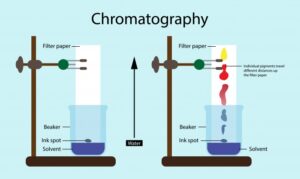
Chromatography is a combination of laboratory techniques that are used for separating the mixture components. Chromatography deals with a sample (or sample extract) dissolved in a mobile phase (a gas, liquid, or a supercritical fluid), which is allowed to move through an immobile and immiscible stationary phase. Selection of phases is done on the basis of solubility of components of the sample in each phase.
DEFINATION: Chromatography is a physical method of separation in which the components to be separated or distributed between two phases, one of which is stationary phase , while the other, the mobile phase moves in a definite direction.
CLASSIEICATION OF CHROMATOGRAPHIC METHODS:
Liquid Chromatography (LC) : Paper Chromatography (PC), Thin layer Chromatography (TLC), High Performance thin layer Chromatography (HPTLC), Adsorption Column Chromatography (ACC), High Performance liquid Chromatography (HPLC), Ion-exchange chromatography (IEC), Affinity chromatography.
Gas-Chromatography : Gas-solid chromatography (GSC) , Gas-Liquid Chromatography (GLC).
Supercritical fluid chromatography (SFC): Super-critical fluid chromatography (SFC) or Bio-affinity chromatography (BC).
APPLICATIONS:
- As a Check on Processes -purification processes.
- For Checking the Purity of Sample.
- Elemental analysis and other physical methods.
- Examination of Reaction.
- For Identifying Organic Compounds.
- Separation of Inorganic Ions (cations, anions, pure covalent species, and some organic derivatives of the metals).
- Separation of Amino Acids.
- Photo-densitometry or Visual Comparison.
- The sample spots (eluted with a proper solvent) are determined with a suitable technique (visual spectrophotometry or Spectro-fluorimetry).
- Measurement of Spot Areas.
- To check the control of purity of pharmaceuticals Drug.
- For detection of Impurities.
- Detect the contaminants in foods and drinks.
- For the detection of drugs.
- In analysis of cosmetics.
- Analysis of the reaction mixtures in biochemical labs.
- Identification of decomposition products Analysis of metabolites of drugs in blood, urine etc.
- In the study of ripening and fermentation.